
Why Self-Hosted AI Fails at Scale: 2026 Inference Economics
Self-hosted LLMs carry a 720M token break-even threshold. At 50M tokens, running dedicated H100 GPUs costs $2,868 monthly vs $200 on cached frontier APIs.

NVIDIA H100 Tensor Core GPU compute module and enterprise unit economics telemetry modeling. The Story Desk Primary Intelligence Desk.
This investigation was independently constructed using published API rate cards, cloud GPU provider pricing schedules, and open-source vLLM throughput benchmarks. OpenAI, Anthropic, Lambda Labs, RunPod, and AWS were not contacted and did not sponsor or participate in the preparation of this report.
01 The Anomaly: The Illusion of Cheap Bare-Metal GPUs
Self-hosting is not a shortcut to cheaper unit economics. Until continuous throughput approaches hardware saturation, closed APIs with aggressive prompt caching deliver vastly superior gross margins with zero operational drag.
Engineering teams frequently assume that renting bare-metal GPUs to host open-weight models (such as Llama 3.3 70B or Qwen 2.5 72B) eliminates vendor markup and saves 60% to 80% on inference spend. [3][6]
The operational arithmetic of modern inference architectures contradicts this assumption. A production workload processing 50 million tokens per month (75% input with 40% prompt caching, 25% output) costs $200.00 per month on frontier API endpoints. [1]
The identical workload routed to a single dedicated NVIDIA H100 GPU on a specialized cloud costs $1,817.70 in raw compute plus $51.00 in storage and egress, and $1,000.00 in shared platform engineering allocation, bringing total monthly expenditure to $2,868.70. [3][6]
At 50 million tokens, self-hosting incurs a 1,334% cost penalty compared to closed APIs. Frontier open-weight self-hosting does not break even until continuous monthly throughput crosses 720.5 million tokens on specialized cloud infrastructure [3][6], and 970.0 million tokens on hyperscalers such as AWS. [5][6] For commodity 8B parameter models, the break-even threshold recedes to 7.59 billion tokens per month. [1][4]
02 The Engine: Reservation Leases vs Dynamic Multi-Tenancy
Closed-model providers and cloud hyperscalers generate revenue through opposing architectural mechanics. [1][3][5] Multi-tenant API providers pool GPU clusters across thousands of concurrent clients, running continuous dynamic batching and prefix caching to minimize idle compute cycles. [1][2]
In contrast, an organization that deploys an open-weight model on self-hosted infrastructure rents capacity on a calendar reservation basis: 730 operational hours per month. [3][5] The company pays full GPU reservation rates even when user query volume drops during nights and weekends. [3][6]
| Workload Tier | Closed API Baseline | Self-Hosted Model | GPU Spec | Hourly Rate | Monthly Base (730h) |
|---|---|---|---|---|---|
| Frontier Flagship | GPT-4o / Claude 3.5 Sonnet | Llama 3.3 70B (FP8 vLLM) | 1x NVIDIA H100 (80GB) | $2.49 / hr | $1,817.70 / mo |
| Frontier Hyperscaler | GPT-4o / Claude 3.5 Sonnet | Llama 3.3 70B (FP8 vLLM) | 1x AWS EC2 p5.48xlarge prorated | $3.85 / hr | $2,810.50 / mo |
| Commodity Lightweight | GPT-4o-mini / Claude 3.5 Haiku | Llama 3.1 8B (FP16 vLLM) | 1x NVIDIA L40S (48GB) | $0.85 / hr | $620.50 / mo |
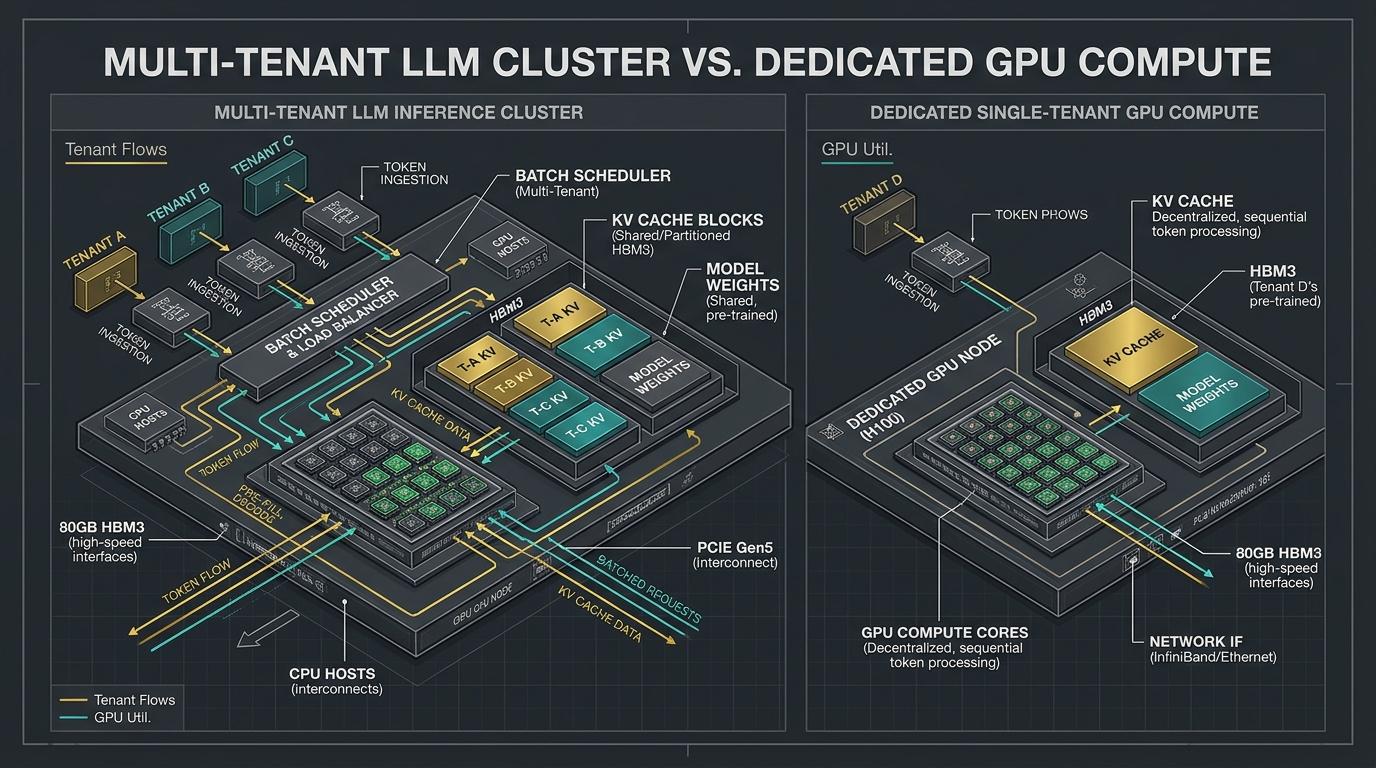
Closed API providers amortize HBM3 VRAM capacity by dynamically scheduling batches across thousands of tenants and reusing prefix-cached prompt blocks. Dedicated single-tenant instances commit full GPU reservation costs regardless of tenant request volume.
The economics of closed endpoints improve because frontier providers discount cached prompt tokens. [1][2] OpenAI charges $2.50 per 1M input tokens and $10.00 per 1M output tokens, but discounts cached inputs by 50% to $1.25 per 1M tokens. [1] Anthropic offers a 90% cache read discount, pricing cached Claude 3.5 Sonnet input tokens at $0.30 per 1M tokens compared to its $3.00 base input rate. [2]
Because self-hosted clusters run fixed compute reservations, a drop in traffic from 100 requests per minute to 5 requests per minute increases the effective cost per generated token by twenty times. [3][6]
03 Inside the Numbers: Fully Burdened Break-Even Modeling
To isolate the structural inflection point where self-hosting becomes accretive, we modeled the fully burdened cost of inference across token scales, incorporating prompt caching and engineering maintenance. [1][3][6]
| Monthly Tokens | Closed API ($4.00/M) | Self-Hosted Compute | Self-Hosted with MLOps | Cost Delta (with MLOps) | Economic Winner |
|---|---|---|---|---|---|
| 10 Million | $40.00 | $1,867.90 | $2,867.90 | +7,069.8% penalty | Closed API |
| 50 Million | $200.00 | $1,868.70 | $2,868.70 | +1,334.4% penalty | Closed API |
| 250 Million | $1,000.00 | $1,872.70 | $2,872.70 | +187.3% penalty | Closed API |
| 500 Million | $2,000.00 | $1,877.70 | $2,877.70 | +43.9% penalty | Closed API |
| 720.5 Million | $2,882.00 | $1,882.11 | $2,882.11 | 0.0% (Break-even) | Parity Inflection |
| 1.00 Billion | $4,000.00 | $1,887.70 | $2,887.70 | -27.8% savings | Self-Hosted |
| 1.80 Billion | $7,200.00 | $1,903.70 | $2,903.70 | -59.7% savings | Self-Hosted |
The monthly financial divergence at lower volumes stems from fixed capital commitments. [1][3] While closed API costs scale linearly from $40.00 at 10M tokens to $2,000.00 at 500M tokens [1], self-hosted infrastructure requires an unavoidable floor of $1,817.70 in GPU lease commitments for 730 monthly hours. [3]
For a frontier 70B model deployed on specialized cloud infrastructure without engineering labor ($1,867.70 base), break-even requires 469.3 million tokens per month. [3][6] Adding 0.10 FTE of platform engineering allocation ($1,000.00 per month) lifts the threshold to 720.5 million tokens. [3][6] On AWS EC2 p5.48xlarge instances ($3.85 per GPU-hour), the threshold climbs to 970.0 million tokens per month. [5][6]
04 Moat vs Fragility: Hardware Locks and Utilization Traps
The primary advantage of self-hosting is data sovereignty and absolute token cost compression at massive, continuous throughput. [3][6] When an application sustains more than 1.5 billion tokens per month at 70% average hardware utilization, self-hosted FP8 vLLM deployments reduce inference COGS by 55% to 65% compared to commercial APIs. [1][3][6] Furthermore, running self-hosted weights inside a private VPC guarantees that proprietary telemetry or enterprise customer data never leaves the internal boundary. [5][6]
The fragility of self-hosted infrastructure lies in traffic volatility, hardware quota availability, and rapid model depreciation. [3][5][6]
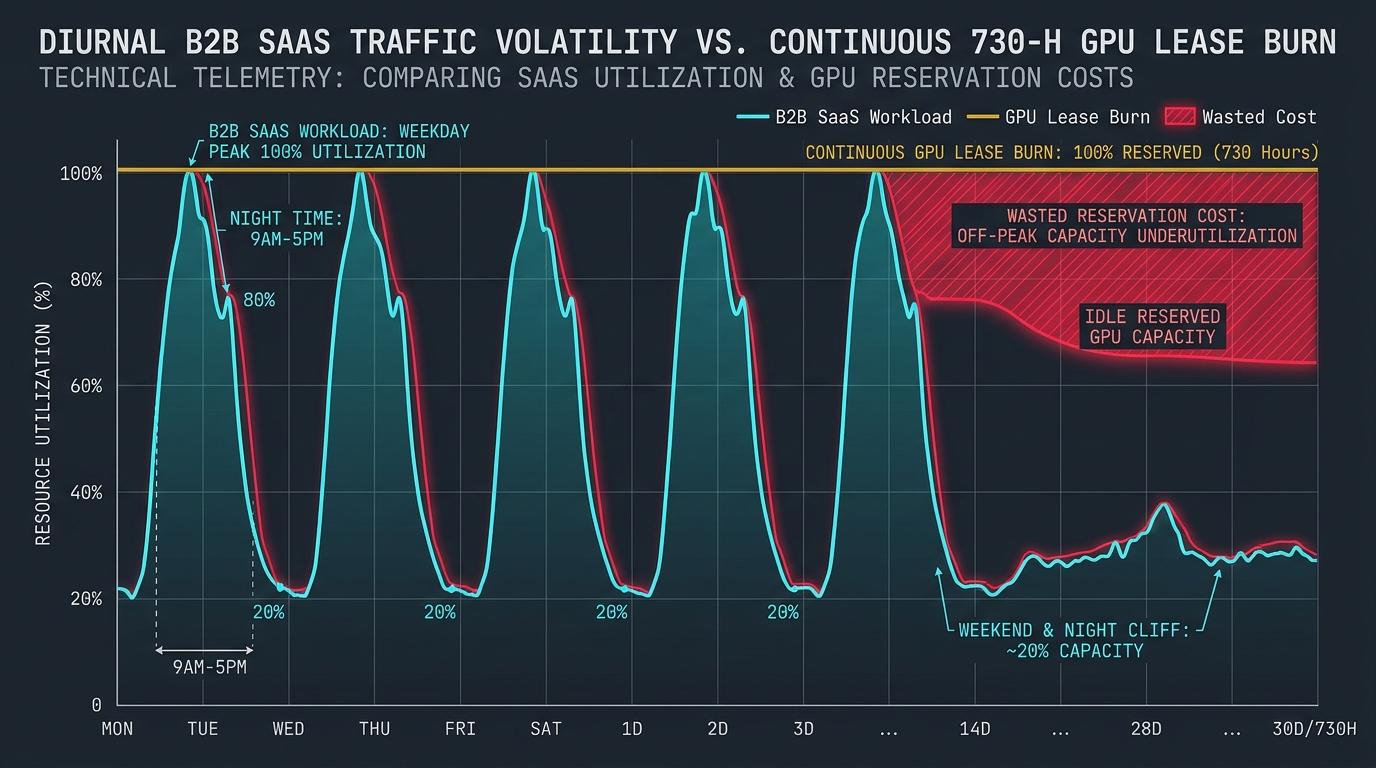
Enterprise B2B software query volume drops by up to 80% during off-peak night and weekend windows. Because bare-metal GPU leases bill 730 hours every month, off-peak idle compute multiplies the effective realized cost per generated token.
B2B software workloads follow diurnal patterns: traffic drops by 80% during nighttime hours and weekend periods. [6] Because GPU reservations run 24 hours a day, the actual realized token generation per dollar drops precipitously. [3][6] If average utilization falls below 35%, a self-hosted cluster operating at 1.0 billion tokens per month loses its cost advantage entirely. [1][3]
Hardware availability introduces secondary fragility. [3][5] Specialized low-cost GPU providers ($2.49/hour) frequently encounter regional stock depletion and lack automatic failover. [3] Hyperscalers charge a 54.6% hourly premium ($3.85 vs $2.49) [3][5], while charging $0.05 to $0.09 per GB in inter-region egress fees. [5]
05 The Operator Takeaway: Capital Allocation for GenAI
Capital allocation for generative AI features requires separating unit economics from infrastructure vanity: [1][3]
Default to Managed APIs Below 500 Million Tokens: Do not provision dedicated H100 clusters until sustained, non-peak traffic consistently exceeds 500 million tokens per month. [1][3] Below this threshold, closed APIs with prompt caching provide superior gross margins with zero operational distraction. [1][2]
Account for the Engineering Payroll Load: Include at least $1,000 to $2,500 per month in fully burdened platform engineering overhead when modeling self-hosted GPU economics. [3][6] A cluster that looks 10% cheaper on raw compute becomes unviable once engineer on-call hours and failure recoveries are loaded. [3]
Use Commodity APIs for Lightweight Tasks: Never self-host 7B or 8B parameter models on rented cloud GPUs unless required by regulatory air-gapping. [1][4] At $0.15 per million input tokens, commercial commodity endpoints require over 7.5 billion monthly tokens to justify dedicated infrastructure. [1][4]
Treat GPU compute as a committed operational expense with high depreciation. Optimize prompt lengths, enable prompt caching on managed APIs, and only migrate to self-hosted clusters when predictable utilization guarantees payback.
Found this analysis valuable?
Save to your reading list, cite in research, or share with engineering peers.
This report was compiled and verified according to The Story Desk's editorial standards. We do not accept payment to influence analytical conclusions. Notice a factual error? Submit an editorial review request through our transparent Corrections Desk.
The Story Desk
Editorial DeskThe Story Desk newsroom provides independent, verifiable reporting and analytical deep-dives across technology, finance, policy, startups, and macroeconomics.
Reader Perspectives & Field Critiques
The Story Desk invites reasoned counterarguments, primary-source corrections, and practitioner field reports. Curated submissions are reviewed by our newsroom and published with author attribution below this piece.
More From Technology & AI
View All Desk Stories →
AWS S3 vs. Cloudflare R2 vs. Backblaze B2 Pricing: Real Egress Cost Math at 10 TB, 100 TB, and 1 PB
A verified November 2026 cost audit of S3-compatible object storage, cloud egress fees, API operation pricing, AWS networking traps, migration fee waivers, and the exact 3.8× break-even threshold.

The 16-Bit Ceiling: Why Indian Engineering Curriculums Fail the Modern Systems Interview
While regulatory circulars recommend advanced computing on paper, premier central institutes represent only ~3.7% of approved engineering intake, while introductory programming laboratories across fee-regulated, non-autonomous affiliated colleges continue to rely on 16-bit DOSBox emulation and handwritten exam booklets.
SigNoz vs Datadog: Observability Costs, ClickHouse Architecture and Trade-offs
An architectural, commercial, and operational teardown of an OpenTelemetry-native observability platform, backed by current published pricing, corrected product claims, a reproducible 100 GB/day model, and verified source notes.