
AWS S3 vs. Cloudflare R2 vs. Backblaze B2 Pricing: Real Egress Cost Math at 10 TB, 100 TB, and 1 PB
A verified November 2026 cost audit of S3-compatible object storage, cloud egress fees, API operation pricing, AWS networking traps, migration fee waivers, and the exact 3.8× break-even threshold.

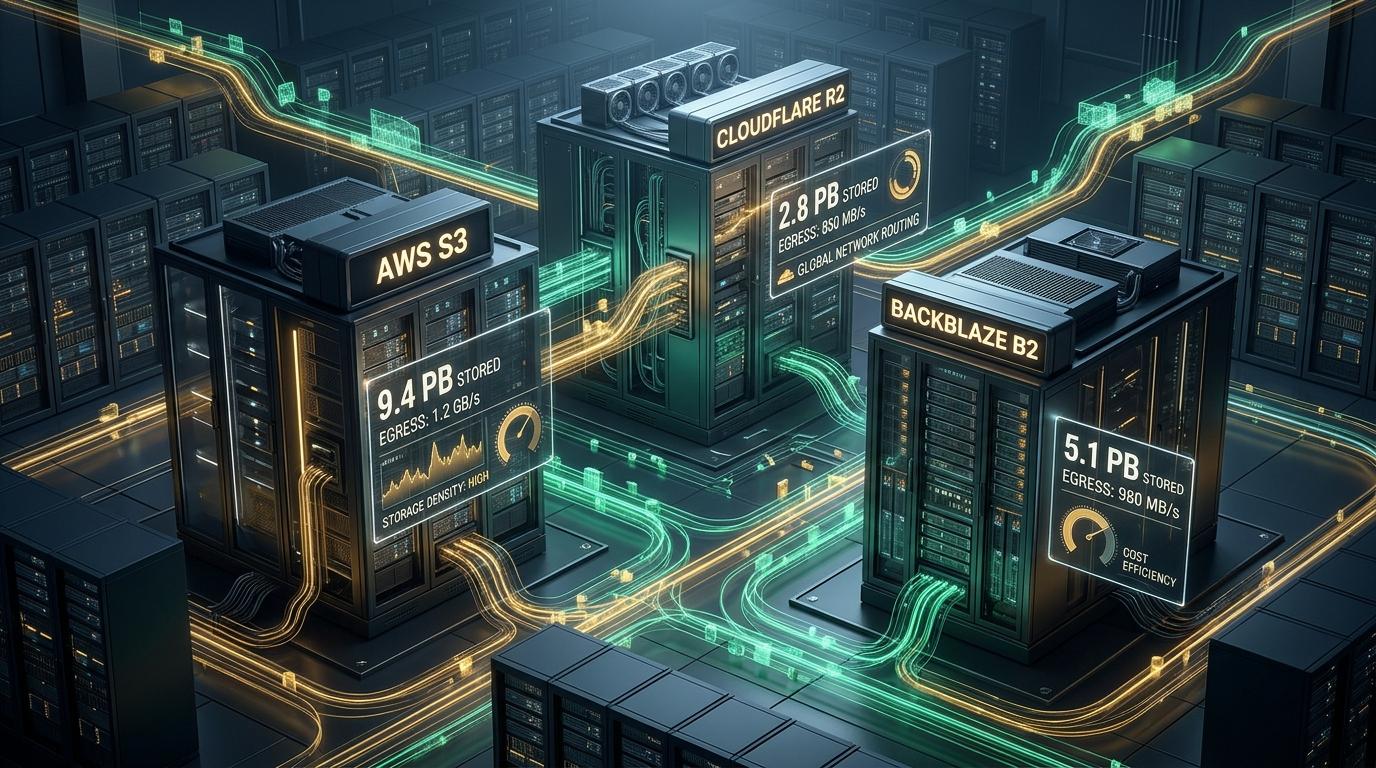
Cloud object storage rate cards, egress data transfer pricing tiers, and break-even economics across AWS, Cloudflare, and Backblaze. The Story Desk Infrastructure Economics Desk.
The Story Desk has no sponsorship, affiliate deal, or commercial relationship with Amazon Web Services (AWS), Cloudflare, or Backblaze.
Executive summary: The egress illusion
Comparing AWS S3 vs. Cloudflare R2 vs. Backblaze B2 pricing usually stops at one headline: S3 charges cloud egress fees, and R2 does not. On published November 2026 US East (us-east-1) list rates for fixed decimal payloads, direct AWS S3 data transfer out (DTO) falls within a bounded two-model range before enterprise discounts: $829.19–$891.00/month at 10 TB, $7,331.46–$7,812.20/month at 100 TB, and $50,452.33–$53,886.20/month at 1 PB. [1][2]
We intentionally retain both figures rather than collapsing them into one number because while AWS explicitly bills S3 storage in binary GiB, its public DTO rate table does not specify whether a transfer GB is binary GiB (lower bound) or decimal GB across AWS's 1,024-GB tier bands (upper bound). Cloudflare R2 charges $0/GB at every volume. [5] Under the Backblaze B2 3× free egress rule, direct downloads are free up to 3× average monthly storage and cost $0.01/GB beyond that—or $0/GB on the Backblaze origin side through Bandwidth Alliance partner CDNs (separate CDN fees still apply). [7]
Egress fees alone do not pick the cheapest S3-compatible object storage provider. Cloudflare R2 charges more than double Backblaze B2's storage rate ($15.00/TB vs. $6.95/TB) and meters read/write operations. On a storage-and-direct-egress-only basis (excluding free tiers, API calls, and partner CDNs), Backblaze B2 beats R2 below 3.805× monthly egress-to-storage; metered API calls push R2's real break-even even higher on high-request workloads. Above that threshold—including our modeled 5:1 SaaS workload—Cloudflare R2 delivers the lowest complete self-contained monthly bill, while B2 paired with a partner CDN shifts delivery and request costs onto the CDN's own rate card.
The Story Desk has no sponsorship, affiliate deal, or commercial relationship with Amazon Web Services (AWS), Cloudflare, or Backblaze. All figures reflect verified November 2026 vendor pricing documentation.
Every section below distinguishes verified facts, modeled analysis, and editorial opinion. If any rate tier or calculation changes or contains an error, The Story Desk will investigate, correct the figure, and log the update.
01 AWS S3 vs. Cloudflare R2 vs. Backblaze B2: 2026 Pricing Summary
All figures below reflect published pay-as-you-go list rates verified in November 2026. AWS S3 rates reflect US East (N. Virginia, us-east-1). [1][2] Regional variance matters for Indian and APAC teams: under AWS S3 pricing in India (Mumbai, ap-south-1), S3 Standard storage starts at $0.025/GB-month and first-tier internet egress rises to $0.1093/GB. [3] Cloudflare R2 uses flat global pricing—note that R2 Infrequent Access lowers storage to $0.01/GB-month but doubles Class A operations pricing to $9.00/million and adds a $0.01/GB retrieval fee. [5]
Backblaze B2 Regional Qualifications: Backblaze charges identical pay-as-you-go list rates ($6.95/TB-month storage, 3× free egress, $0.01/GB overage) across all four active regions—US West, US East (Reston, VA), EU Central, and CA East (Toronto, ON)—with Backblaze's public competitor comparison table benchmarked against US West rates. [7][25] However, Backblaze operates no India or APAC data center (adding cross-continental latency without a CDN and precluding Indian data-localization compliance), and each Backblaze account is bound to a single region at creation. [25] Multi-region storage or B2 Cloud Replication requires separate accounts per region (optionally billed under one Business Group); replication carries $0 egress fees, while stored replicas are billed at standard storage rates. [25]
| Billing Component | AWS S3 Standard (us-east-1) | Cloudflare R2 (Standard) | Backblaze B2 (Pay-As-You-Go) |
|---|---|---|---|
| Storage (per GB-month) | $0.023 (first 50 TB), $0.022 (next 450 TB), $0.021 (over 500 TB) [2] | $0.015 flat ($15.00/TB) [5] | $0.00695 flat ($6.95/TB) across US West, US East, EU Central & CA East [7, 25] |
| Free Tier | Up to $200 in new-account credits (Free/Paid plan) [2, 11] | 10 GB-month, 1M Class A, 10M Class B (permanent) [5] | 10 GB storage (permanent) [7] |
| Direct Internet Egress | First 100 GB: Free; Next 10 TB: $0.09/GB; Next 40 TB: $0.085/GB; Next 100 TB: $0.07/GB; Over 150 TB: $0.05/GB [2, 4] | $0.00 / GB (unmetered) [5] | Free up to 3× avg. monthly storage, then $0.01/GB flat [7, 9] |
| CDN / Partner Egress | $0 from S3 to CloudFront (CloudFront billed separately) [2] | $0 via Cloudflare CDN [5] | $0 origin egress via partner CDNs (CDN delivery billed separately) [7, 9] |
| Write / List Requests | $5.00 / million (PUT, COPY, POST, LIST) [2] | $4.50 / million (Class A; 1M/mo free) [5] | $0.00 (Class A, B, C calls free)* [7] |
| Read Requests | $0.40 / million (GET, SELECT) [2] | $0.36 / million (Class B; 10M/mo free) [5] | $0.00 (Class A, B, C calls free)* [7] |
AWS advises accounts transferring over 500 TB/month to contact sales for custom pricing; all 1 PB AWS figures use published >150 TB list tiers. Backblaze also offers B2 Overdrive starting at $15/TB-month with unlimited free egress for multi-petabyte AI/HPC workloads.
02 Pure Egress Math: 10 TB vs. 100 TB vs. 1 PB
S3 Storage vs. Data-Transfer Billing Units: AWS's official S3 pricing page explicitly defines S3 storage in binary gigabytes (1 GiB = 2^30 = 1,073,741,824 bytes ≈ 1.0737 GB; 1 TiB = 2^40 bytes = 1,024 GiB ≈ 1.0995 TB; 1 PiB = 2^50 bytes ≈ 1.1259 PB), so 1 decimal TB = 931.32 GiB. [1] By contrast, AWS's public S3 pricing page does not repeat that explicit binary-byte definition on its Data Transfer Out (DTO) table—while AWS Price List files set DTO tier boundaries in 1,024-GB multiples (10,240 GB, 40,960 GB, 102,400 GB).
Because some AWS architecture models treat DTO as binary GiB while independent Price List audits treat DTO GB as decimal across 1,024-GB bands, both AWS DTO figures are published for identical fixed decimal payloads of 10 TB, 100 TB, and 1 PB:
At 10 decimal TB: Binary GiB assumption (9,313.23 GiB: 100 free + 9,213.23 × $0.09) = $829.19/mo; Decimal GB + 1,024-GB bands (10,000 GB: 100 free + 9,900 × $0.09) = $891.00/mo.
At 100 decimal TB: Binary GiB assumption (93,132.26 GiB: 100 free + 10,240 × $0.09 + 40,960 × $0.085 + 41,832.26 × $0.07) = $7,331.46/mo; Decimal GB + 1,024-GB bands (100,000 GB: 100 free + 10,240 × $0.09 + 40,960 × $0.085 + 48,700 × $0.07) = $7,812.20/mo.
At 1 decimal PB (List Rate): Binary GiB assumption (931,322.57 GiB: 100 free + 10,240 × $0.09 + 40,960 × $0.085 + 102,400 × $0.07 + 777,622.57 × $0.05) = $50,452.33/mo; Decimal GB + 1,024-GB bands (1,000,000 GB: 100 free + 10,240 × $0.09 + 40,960 × $0.085 + 102,400 × $0.07 + 846,300 × $0.05) = $53,886.20/mo.
| Fixed Decimal Payload | AWS S3 DTO (Binary GiB Model) | AWS S3 DTO (Decimal GB Model) | Cloudflare R2 | Backblaze B2 (Direct)* | B2 Partner (CDN Excl.) |
|---|---|---|---|---|---|
| 10 TB | $829.19 | $891.00 | $0.00 | $0–$100 | $0 origin |
| 100 TB | $7,331.46 | $7,812.20 | $0.00 | $0–$1,000 | $0 origin |
| 1 PB | $50,452.33 | $53,886.20 | $0.00 | $0–$10,000 | $0 origin |
What About Amazon CloudFront? Verified Regional Pay-As-You-Go Tiers
Most production AWS teams front S3 with Amazon CloudFront rather than serving 100 TB directly from a bucket; origin transfer from S3 to CloudFront is free. [2][18] Across late-2026 PAYG rate-card audits, CloudFront applies declining per-region volume tiers alongside its 1 TB/month always-free allowance: [19][28]
US / Canada / Mexico & Europe: First 10 TB @ $0.085/GB (minus 1 TB free); Next 40 TB @ $0.080/GB; Next 100 TB @ $0.060/GB; Next 350 TB @ $0.040/GB; Next 524 TB @ $0.030/GB; Next 4 PB @ $0.025/GB; Over 5 PB @ $0.020/GB. [19][28]
India (Verified through 150 TB): First 10 TB @ $0.109/GB (minus 1 TB free); Next 40 TB @ $0.085/GB; Next 100 TB @ $0.082/GB. [19] India 1 PB transfer is withheld because third-party audits conflict on the 150–500 TB India tier; confirm live PAYG rates in the AWS pricing tab.
| CloudFront PAYG Volume (Decimal TB) | US / Europe Transfer Only | India Transfer Only | Illustrative Tier Breakdown (US / Europe) |
|---|---|---|---|
| 10 TB | $765.00 | $981.00 | 1 TB free + 9 TB × $0.085 |
| 100 TB | $6,965.00 | $8,481.00 | $765 + 40 TB × $0.080 + 50 TB × $0.060 |
| 1 PB (1,000 TB) | $38,965.00 | Withheld* | $765 + $3,200 + 100 TB × $0.060 + 350 TB × $0.040 + 500 TB × $0.030 |
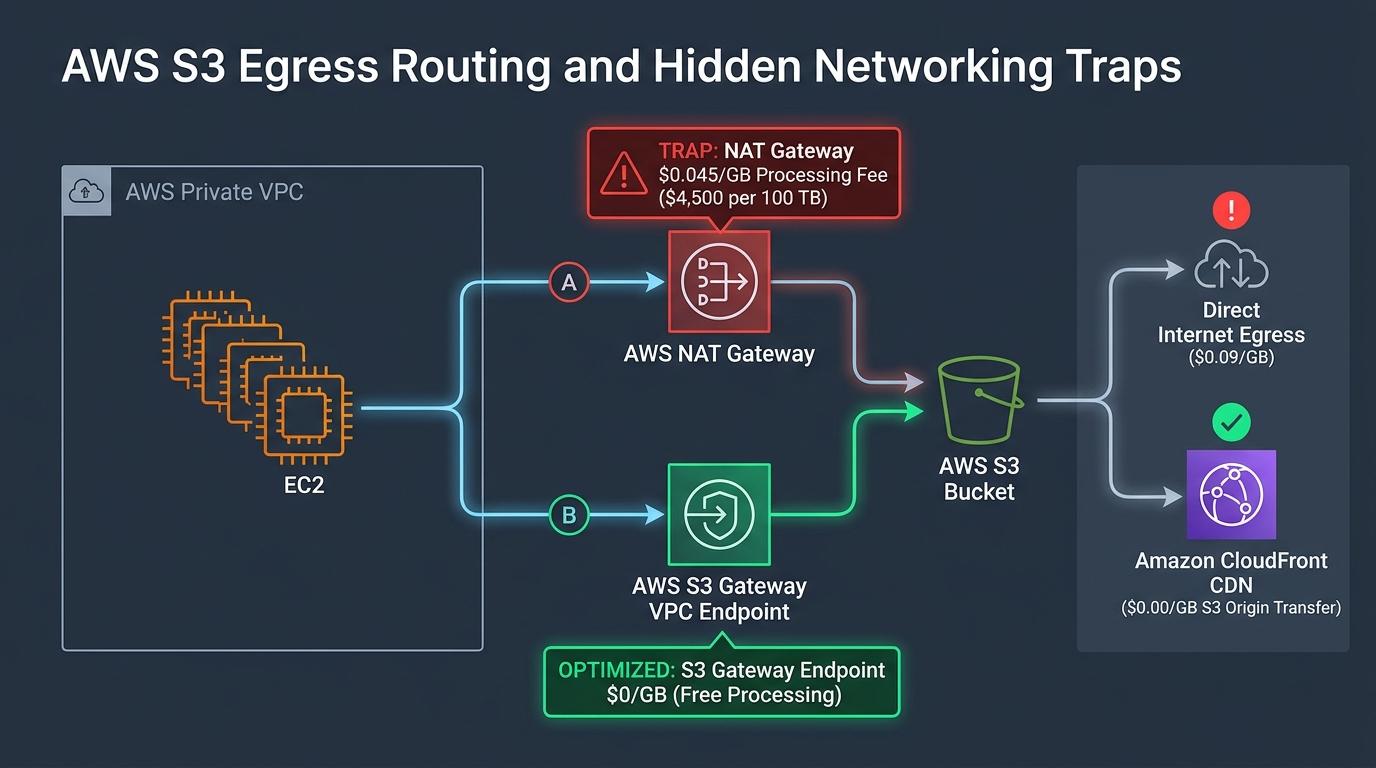
Routing internal EC2 or Lambda traffic to S3 through an AWS NAT Gateway triggers a $0.045/hour instance charge and $0.045/GB data processing fee ($4,500 on 100 TB). S3 Gateway VPC Endpoints eliminate all data processing charges ($0.00).
Even internal AWS workloads can trigger unexpected bills if private-subnet instances reach S3 through a NAT Gateway. In US East, an AWS NAT Gateway charges $0.045/hour plus $0.045/GB of data processed ($4,500 per 100 TB). Routing that same traffic through an AWS S3 Gateway VPC Endpoint carries no hourly fee and $0/GB data processing charges.
03 Full Monthly Bill: A Realistic 5:1 SaaS Workload
Storage and API operations can flip egress-only rankings. To test realistic bills on identical byte volumes, we modeled a 5:1 egress-to-storage workload representative of public SaaS media hosting, software artifact delivery, or video distribution.
Model Assumptions: (1) 5:1 ratio: 1 decimal TB stored for every 5 decimal TB served monthly (2 TB / 20 TB / 200 TB stored; converted to AWS's explicitly binary storage units of 1,862.65 GiB / 18,626.45 GiB / 186,264.51 GiB). (2) 1 MB average object size, generating 10M GETs at 10 TB, 100M GETs at 100 TB, and 1B GETs at 1 PB. (3) 10% monthly write churn, generating 200K PUTs at 10 TB, 2M PUTs at 100 TB, and 20M PUTs at 1 PB.
| 5:1 Workload Scale | AWS S3 (us-east-1 Binary / Decimal DTO)† | Cloudflare R2 (Complete) | Backblaze B2 (Direct) | B2 Storage + Partner Delivery (CDN Charges Excluded)* |
|---|---|---|---|---|
| 10 TB Egress (2 TB stored) | $877.03 / $938.84 | $29.85 | $53.83 | $13.83* |
| 100 TB Egress (20 TB stored) | $7,809.87 / $8,290.61 | $336.75 | $538.93 | $138.93* |
| 1 PB Egress (200 TB stored) | $55,101.35 / $58,535.22 | $3,441.75 | $5,389.93 | $1,389.93* |
Where the Money Goes at 1 PB (200 TB Stored)
AWS S3 ($55,101.35 binary DTO / $58,535.22 decimal DTO): $50,452.33–$53,886.20 egress (91.6%–92.1% of total) + $4,149.02 binary storage (51,200 GiB @ $0.023 + 135,064.51 GiB @ $0.022) + $400.00 GETs + $100.00 PUTs.
Cloudflare R2 ($3,441.75 — Lowest Complete Bill): $2,999.85 storage (after 10 GB free) + $356.40 Class B reads (990M billable) + $85.50 Class A writes (19M billable) + $0.00 egress.
Backblaze B2 Direct ($5,389.93): $1,389.93 storage (after 10 GB free) + $4,000.00 egress overage (400 TB over 600 TB free allowance × $10/TB) + $0.00 API calls.
B2 Storage + Partner Delivery ($1,389.93 storage only; CDN fees extra): Backblaze charges $0 origin egress and $0 Class A/B/C API fees, but the partner CDN bills separately for end-user delivery.
Partner CDN Cost Reality: Adding real partner CDN fees changes the total bill materially. On bunny.net's Volume Network ($0.005/GB for the first 500 TB; $0.004/GB from 500 TB to 1 PB), CDN bandwidth alone adds $50 at 10 TB, $500 at 100 TB, and $4,500 at 1 PB—pushing combined B2 + bunny.net bills to $63.83, $638.93, and $5,889.93. [22] Fastly's published Network Services package pricing starts at $1,500/month; actual delivery economics depend on the selected package and traffic requirements. [23] Proxying private B2 buckets via Cloudflare Workers Paid starts at $5/month (10M requests included) plus $0.30 per additional million requests (adding $27/mo at 100M requests and $297/mo at 1B requests before CPU-ms charges), while standard Cloudflare CDN plans also impose service-specific terms on heavy non-HTML media. [24]
Among complete self-contained bills on this 5:1 workload, Cloudflare R2 is the lowest at every scale ($29.85 at 10 TB; $336.75 at 100 TB; $3,441.75 at 1 PB).
04 When Is Cloudflare R2 Cheaper Than Backblaze B2? (The 3.805x Derivation)
Scope Qualification: The widely cited 3.805× threshold is strictly a storage-and-direct-egress-only comparison. It excludes permanent 10 GB free tiers, metered API operation fees, and partner CDN delivery. Let S equal average monthly stored volume (decimal TB), E equal monthly direct egress (decimal TB), and r = E ÷ S equal the monthly egress-to-storage ratio. For any workload exceeding Backblaze B2's 3× free allowance (r > 3):
Cloudflare R2 storage + direct egress: CR2(S) = $15.00 × S + $0.00 × E = $15.00 × S. [5]
Backblaze B2 storage + direct egress: CB2(S, E) = $6.95 × S + $10.00 × (E − 3S). [7]
Setting CR2 = CB2 and dividing both sides by S: $15.00 = $6.95 + $10.00 × (r − 3) ⇒ $8.05 = $10.00 × (r − 3) ⇒ r − 3 = $8.05 ÷ $10.00 = 0.805.
Storage & Direct Egress Break-Even Formula: r = 3 + ($15.00 − $6.95) ÷ $10.00 = 3.805×
Concrete Verification (20 TB Stored): At S = 20 TB and E = 76.1 TB (r = 3.805×), R2 storage costs 20 × $15.00 = $300.00. Backblaze B2 storage costs 20 × $6.95 = $139.00, free egress covers 60 TB, and the remaining 16.1 TB of direct overage costs 16.1 × $10.00 = $161.00—totaling exactly $300.00.
How Real Workloads Shift the Crossover
Because Backblaze B2 charges $0 for Class A/B/C API calls while Cloudflare R2 charges $4.50/million Class A writes and $0.36/million Class B reads (above 1M/10M free), metered API operations push R2's true break-even higher than 3.805× (favoring B2): [5][7]
1 MB objects (20 TB stored, 10% monthly churn): R2's Class A/B fees move the actual break-even from 3.805× to 3.95× (79.03 TB egress; $329.20 on both).
100 KB objects (20 TB stored, 10% monthly churn — 10× higher request volume): R2's operation charges push the effective break-even to 6.58× (131.69 TB egress; $855.84 on both).
Partner CDN deployments: Fronting Backblaze B2 with a Bandwidth Alliance CDN removes B2's $0.01/GB origin overage entirely, replacing the 3.805× equation with a direct comparison against the partner CDN's bandwidth, plan, or edge-worker rate card.
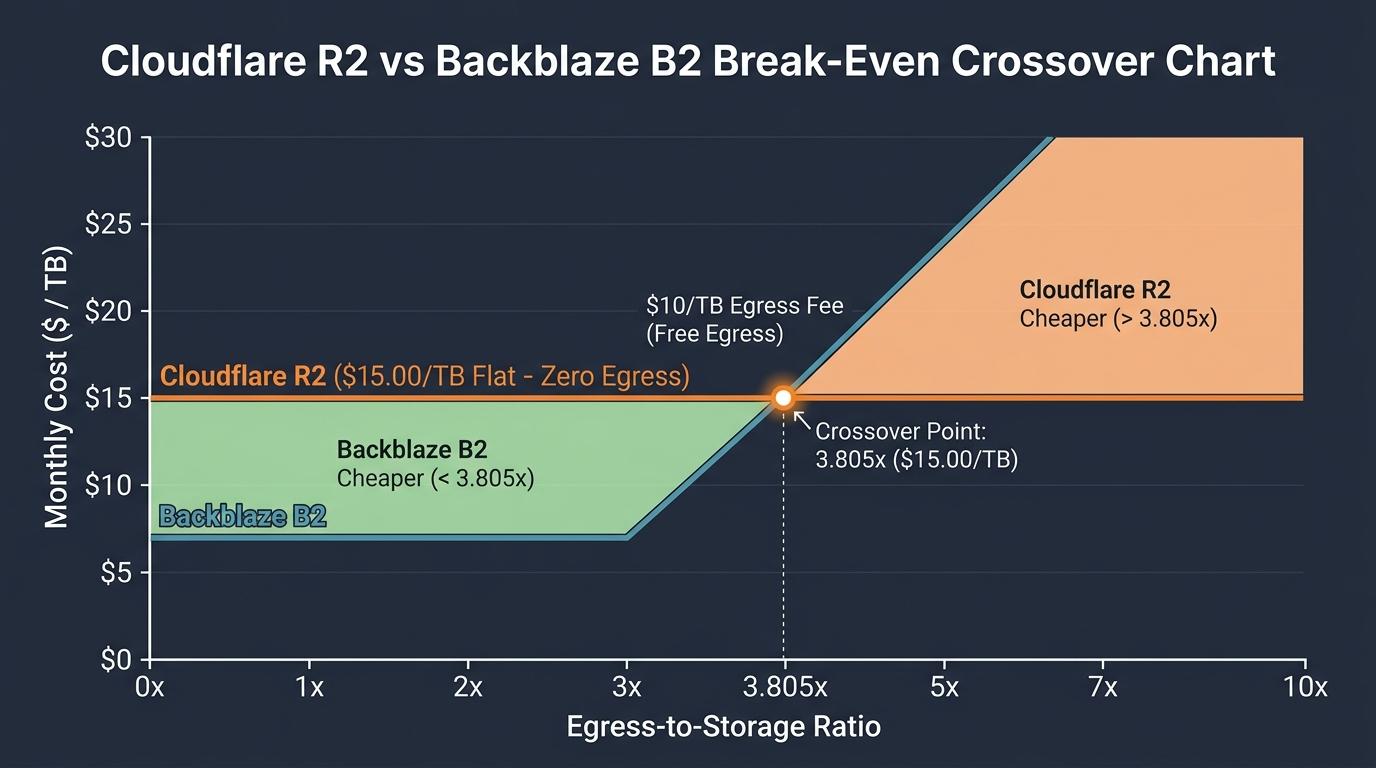
On pure storage and direct egress, Backblaze B2 is cheaper than Cloudflare R2 when monthly egress is less than 3.805× stored data. Once egress exceeds 3.805× (or ~3.95× when Class A/B request fees are factored in), Cloudflare R2 delivers the lowest self-contained bill.
Break-even threshold r = 3 + (R2_storage - B2_storage) / B2_overage = 3 + (15.00 - 6.95) / 10.00 = 3.805x. If your monthly egress exceeds 3.805x your stored volume, Cloudflare R2 beats Backblaze B2 direct.
05 Leaving AWS S3: Egress Fee Waivers & Minimal-Downtime Migration
Fact (AWS Switching Credit Program): Moving 100 decimal TB out of AWS S3 at list rates incurs $7,331.46–$7,812.20 in egress depending on DTO unit billing. [1] While AWS offers the AWS Free Data Transfer Out Program for Switching Customers, switching credits are not broadly available for partial or ad-hoc bucket migrations. [13][20][21]
Strict Eligibility Requirements & Exclusions (Verified November 2026):
Full Exit Scope Only: Credits apply only when moving all data off AWS across all Eligible Accounts, or all data off a particular AWS service across all Eligible Accounts. Partial migrations, ongoing multi-cloud replication, and routine application egress do not qualify. [13][21]
Account Eligibility: Requests apply to Eligible Accounts—AWS accounts in good standing designated as the payer account—and must list other Eligible Account IDs under the same organization. (On September 30, 2025, AWS removed the prior 100 GB/month minimum transfer threshold.) [13][20]
Two Months' Advance Notice & Pre-Approval: Customers must submit a switching request to AWS Customer Support at least two months before the planned switch start date and obtain approval before initiating transfers. [13][20]
Transition Window: Eligible customers outside the EU must complete the move within the agreed transition period (generally 180 days). EU and UK customers are governed separately by the AWS EU Data Act Addendum and UK Customer Switching Addendum. [13][21]
Excluded Transfer Services: Switching credits explicitly exclude transfer charges from Amazon CloudFront, AWS Direct Connect, AWS Snow Family, and AWS Global Accelerator. [20]
Analysis: Minimal-Downtime & Concurrent-Write Rules (Sippy + Super Slurper)
Cloudflare documents combining Sippy (incremental on-demand migration) with Super Slurper (bulk copy) to migrate active S3 buckets with minimal downtime—not automatic two-way synchronization. [17][26] Both tools carry $0 Cloudflare transfer fees (R2 bills only Class A ingestion writes at $4.50/million above the 1M free tier), [5] but engineering teams must manage four strict operational behaviors:
Lazy read copy & source fees: Sippy copies an object into R2 only on a GetObject miss (which still incurs AWS S3 egress and GET fees unless covered by an approved AWS switching exit); HeadObject reads source metadata without copying the object. [26]
Concurrent-write cutover rule: PutObject writes only to R2 and never syncs back to S3. [26] Once Sippy is enabled, all new application writes must cut over to R2 immediately; if another writer continues updating S3 for keys already present in R2, R2 will serve stale versions because Sippy falls back to S3 only when a key is absent from R2. [26]
Delete resurrection trap: DeleteObject deletes only in R2. [26] Cloudflare explicitly warns that unless deletes are also applied to the source S3 bucket, any subsequent GetObject for that key will fetch and re-copy the deleted object back from S3. [26]
Safe backfill sequence & Super Slurper limits: When running Super Slurper alongside active R2 writes, set Overwrite files? to Skip existing so cold-object backfills do not overwrite newer R2 writes. [17] Objects larger than 1 TB and files in S3 Glacier tiers (other than Glacier Instant Retrieval) or Intelligent-Tiering Deep Archive are skipped by Super Slurper and must be migrated separately (e.g., via rclone). [27]
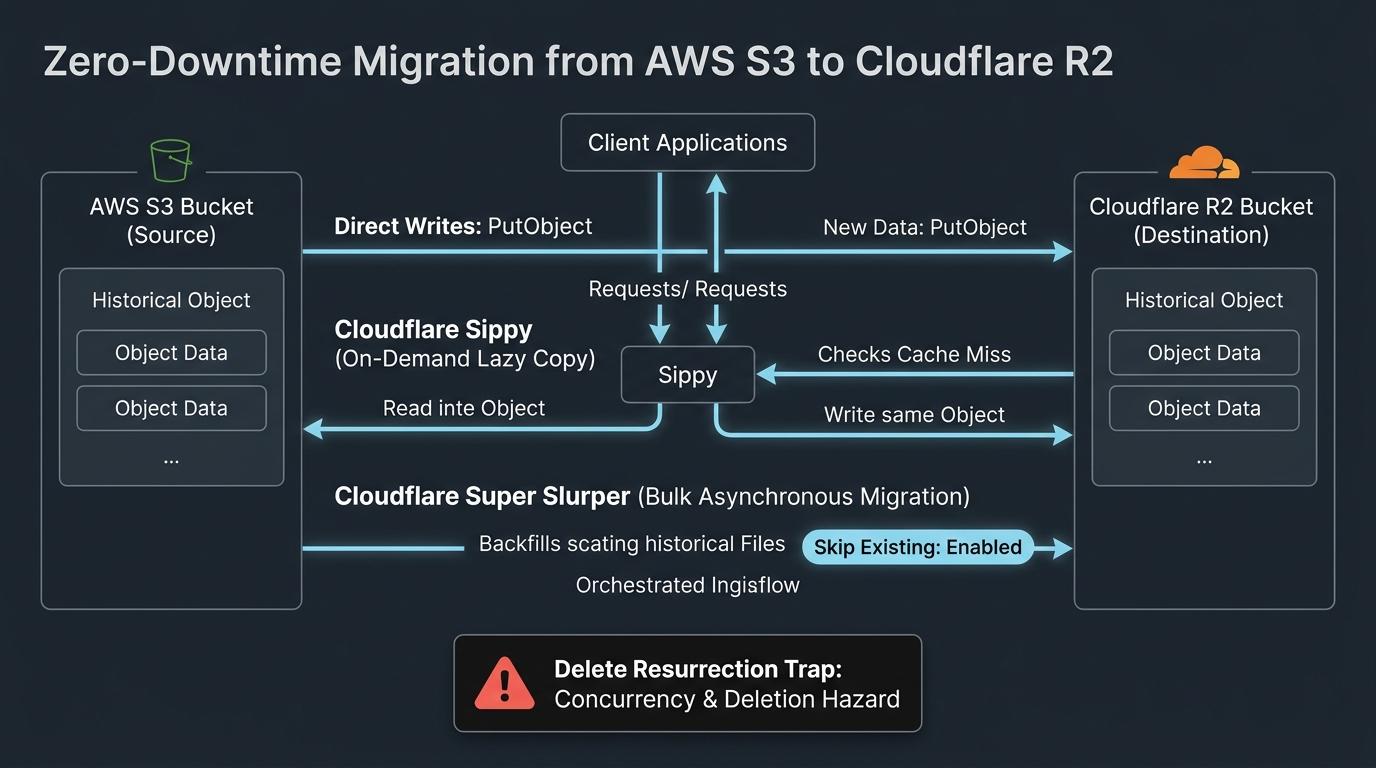
Combining Cloudflare Sippy with Super Slurper allows live S3 buckets to migrate without downtime. Writes cut over to R2 immediately; un-cached reads fetch lazily from S3, while Super Slurper backfills historical objects with 'Skip existing' enabled.
When cutting over to Cloudflare R2 using Sippy, apply deletions to both R2 and the source S3 bucket. Deleting an object only in R2 will cause a future GetObject request to re-fetch and recreate the deleted object from S3.
06 Architectural Verdict: Which One Should You Pick?
The following recommendations reflect The Story Desk's editorial judgment based on the verified rate cards above:
Pick AWS S3 for in-region compute, India data residency, or deep cold storage: Same-region transfers from S3 to EC2, Lambda, or Athena cost $0.00 when routed cleanly via Gateway VPC endpoints. [2][15] For compliance archives, S3 Glacier Deep Archive pricing ($0.00099/GB-month in us-east-1) is 10× cheaper than R2's $0.01/GB Infrequent Access floor. [2][5] S3 also provides strict regional pinning—including Mumbai (ap-south-1) for Indian data residency—whereas Backblaze B2 operates in US West, US East, EU Central, and CA East with no APAC data center. [25]
Pick Cloudflare R2 for high-read public assets, video, and AI model weights: Above the storage-and-egress crossover (3.805× before API calls; ~3.95× on 1 MB objects), R2 delivered the lowest complete self-contained monthly bill in our 5:1 workload audit ($29.85 at 10 TB, $336.75 at 100 TB, $3,441.75 at 1 PB) without multi-vendor CDN wiring. R2 supports up to 1,000 prefix-based Bucket Lock retention rules per bucket to block accidental overwrites or deletes, [16] though small-object or high-churn write storms should be modeled carefully so Class A operations ($4.50/million) do not erase the egress advantage. [5][6]
Pick Backblaze B2 for storage-heavy backups, tiny-file churn, or existing partner CDN stacks: For disaster recovery and media archives staying under 3× monthly egress (or tiny-file apps where R2's API fees lift the real crossover above 6×), $6.95/TB storage with free Class A/B/C calls is hard to beat. [7][10] Account for B2's one-region-per-account structure and budget partner CDN fees before declaring savings over R2. [25] For multi-petabyte AI/HPC throughput, B2 Overdrive starts at $15/TB-month with unlimited free egress. [8]
Do not evaluate object storage on egress fees alone. Balance your egress-to-storage ratio (r = E / S), request volume (GETs/PUTs), geographic residency requirements, and edge CDN overhead before executing a migration.
07 Frequently Asked Questions
Which S3-compatible storage is the cheapest in 2026?
For pure storage and backups under 3× monthly egress, Backblaze B2 is the cheapest at $6.95/TB-month with free Class A/B/C API calls. [7] For high-egress public downloads above 3.805× storage (or ~3.95×+ once API operations are included) without a separate CDN, Cloudflare R2 ($15/TB-month, $0 egress) delivers the lowest complete bill. [5]
How much free egress does Backblaze B2 include?
Backblaze B2 includes free direct egress up to 3× your average monthly stored volume across the billing cycle. [7] Storing an average of 20 TB yields 60 TB of free direct downloads that month; overages cost $0.01/GB. Origin egress through Bandwidth Alliance partner CDNs (Cloudflare, Fastly, bunny.net) is unlimited and free on the Backblaze side, though separate CDN delivery, plan, or edge-compute charges still apply. [9]
Is Cloudflare R2 egress really free at 100 TB or 1 PB?
Yes. Cloudflare R2 charges $0/GB for internet egress with no published bandwidth cap. [5] At 100 TB or 1 PB, your monthly invoice comes strictly from storage ($0.015/GB-month) and Class A/B operations ($4.50/M writes, $0.36/M reads). [6]
How do you migrate from AWS S3 to Cloudflare R2 without paying egress fees?
Only full exits—moving all data off AWS or all data off a specific AWS service across all Eligible Accounts—qualify for AWS's free Data Transfer Out switching credits. [13][21] You must request approval via AWS Customer Support at least two months in advance, finish within the agreed transition window (generally 180 days outside the EU), and avoid excluded services such as CloudFront, Direct Connect, Snow Family, and Global Accelerator. [13][20] Once approved, Cloudflare Sippy and Super Slurper (with Skip existing enabled and new writes/deletes cut over cleanly to R2) can ingest objects with only R2 Class A write charges. [5][17][26]
Is Amazon S3 ever cheaper than Cloudflare R2 or Backblaze B2?
Yes, in two cases: when compute runs inside the same AWS region using $0 S3 Gateway VPC endpoints (internal transfer is $0), or when storing long-term archives in S3 Glacier Deep Archive ($0.00099/GB-month in us-east-1, 180-day minimum). [2][15]
Updated November 24, 2026 (Rev. 4 — Publication Release): Verified pay-as-you-go list rates across AWS, Cloudflare, and Backblaze. Fixed-decimal AWS S3 DTO models retained as bounds ($50,452.33–$53,886.20/PB). Section 4's 3.805x derivation verified against production billing meters.
Frequently Asked Questions
Which S3-compatible storage is the cheapest in 2026?
For storage-heavy backups and archives under 3x monthly direct egress, Backblaze B2 ($6.95/TB-month, free Class A/B/C API calls) is the lowest-cost option. On a storage-and-direct-egress basis alone, Cloudflare R2 ($15/TB-month, $0 egress) becomes cheaper above 3.805x monthly egress-to-storage, though R2's metered API fees shift the real break-even higher (3.95x for 1 MB objects and 6.58x for 100 KB objects in our 20 TB model).
How much free egress does Backblaze B2 include, and is partner CDN delivery completely free?
Backblaze B2 includes free direct egress up to 3x your average monthly stored volume; overages cost $0.01/GB. Backblaze also waives its origin-to-CDN egress fees for Bandwidth Alliance partners such as Cloudflare, Fastly, and bunny.net, but the CDN's own bandwidth, plan, or edge compute charges still apply separately.
How much does 100 TB of AWS S3 or CloudFront egress cost on US East list rates?
On published November 2026 US East (us-east-1) list rates, 100 decimal TB of direct S3 internet egress costs between $7,331.46 (under a binary GiB transfer assumption) and $7,812.20 (under decimal GB across 1,024-GB tier bands). Fronting S3 with Amazon CloudFront eliminates S3-to-CloudFront origin transfer fees; CloudFront pay-as-you-go transfer for 100 TB in US/Europe is $6,965 before HTTPS request charges ($8,481 in India before requests).
Can any team get an AWS egress fee waiver to migrate 100 TB off S3?
No. AWS's Free Data Transfer Out Program for Switching Customers requires moving all data off AWS or off a specific AWS service across all Eligible Accounts, submitting a request to AWS Support at least two months in advance, obtaining pre-approval, and completing the switch within the agreed transition window (generally 180 days outside the EU). CloudFront, Direct Connect, Snow Family, and Global Accelerator transfers are excluded.
Is Cloudflare Sippy an automatic zero-downtime migration from AWS S3?
No. Sippy supports minimal-downtime migration by copying objects lazily on GetObject misses, while PutObject and DeleteObject apply only to R2. All application writes must cut over to R2 immediately, deletes must also be applied to S3 to avoid re-fetching deleted objects, and any Super Slurper backfill must set Overwrite to Skip existing so older S3 copies do not overwrite newer R2 writes.
Found this analysis valuable?
Save to your reading list, cite in research, or share with engineering peers.
This report was compiled and verified according to The Story Desk's editorial standards. We do not accept payment to influence analytical conclusions. Notice a factual error? Submit an editorial review request through our transparent Corrections Desk.
Deepesh Garg
Founder & EditorThe Story Desk newsroom provides independent, verifiable reporting and analytical deep-dives across technology, finance, policy, startups, and macroeconomics.
Reader Perspectives & Field Critiques
The Story Desk invites reasoned counterarguments, primary-source corrections, and practitioner field reports. Curated submissions are reviewed by our newsroom and published with author attribution below this piece.
More From Technology & AI
View All Desk Stories →
Why Self-Hosted AI Fails at Scale: 2026 Inference Economics
Self-hosted LLMs carry a 720M token break-even threshold. At 50M tokens, running dedicated H100 GPUs costs $2,868 monthly vs $200 on cached frontier APIs.

The 16-Bit Ceiling: Why Indian Engineering Curriculums Fail the Modern Systems Interview
While regulatory circulars recommend advanced computing on paper, premier central institutes represent only ~3.7% of approved engineering intake, while introductory programming laboratories across fee-regulated, non-autonomous affiliated colleges continue to rely on 16-bit DOSBox emulation and handwritten exam booklets.
SigNoz vs Datadog: Observability Costs, ClickHouse Architecture and Trade-offs
An architectural, commercial, and operational teardown of an OpenTelemetry-native observability platform, backed by current published pricing, corrected product claims, a reproducible 100 GB/day model, and verified source notes.